
Colorado Springs, CO Restaurant Insurance

See How We're Different
or call us: 1-800-969-9740
Picture a Saturday in July: a hailstorm rolls off Pikes Peak at 4 p.m., shreds your rooftop condenser, and knocks out power to your walk-in for six hours. By the time dinner service should start, you're throwing away $8,000 in protein and calling a refrigeration tech who can't come until Monday. That's a normal summer risk for a restaurant on the Front Range, not a freak event.
Insurance for a Colorado Springs restaurant covers general liability, property, liquor liability, equipment breakdown, workers' compensation, and costs. Each piece covers a different way your business can bleed money, and the gaps between them are where most owners get hurt. I've watched operators assume their "business policy" covered spoiled inventory, a server's slip on a wet floor, or a drunk patron's car crash. Sometimes it did. Often it didn't.
This guide walks through each coverage the way an experienced broker would explain it across the table. It also covers what actually drives your premiums in El Paso County. One
uncovered claim can wipe out three years of thin restaurant margins, and that's a risk you can control.
The Risk Landscape for Colorado Springs Restaurateurs
Colorado Springs has a few risk factors that set it apart from Denver or the mountain towns. Weather is the biggest one. Colorado ranks 2nd in the U.S. for hail-related damage, and the Springs sits squarely in Hail Alley. Rooftop HVAC units, exhaust fans, skylights, and patio furniture all take the beating, and carriers price that exposure into every property quote.
Liability exposure also changed recently. House Bill 24-1472 raised damage caps for civil claims starting January 1, 2025, and those higher caps carry through 2026. The practical effect: a serious customer injury or dram shop claim can now produce a larger judgment than it would have a few years ago. If your liability limits haven't been reviewed since 2024, they're probably set against a smaller worst case than the one you face today.
Labor costs feed directly into your insurance bill too. As of January 1, 2026, the Colorado minimum wage is $15.16 per hour, with a tipped rate of $12.14. Colorado Springs follows the state rate rather than setting its own like Denver does. Since workers' comp premiums are calculated on payroll, every wage bump raises your premium base.
Then there's the local customer mix. You've got military families from Fort Carson, Peterson, and Schriever, a large tourist season around Garden of the Gods and Manitou, and a busy Air Force Academy graduation weekend. That means seasonal staffing swings, crowded dining rooms, and alcohol sales that spike on predictable weekends. All of it shapes how underwriters see you.
By: John R. Thomas
Commercial Lines Director and Managing Partner at Loft & Co Insurance Services
Foundational Coverage: General Liability and Commercial Property
These two coverages are the floor. Landlords require them, lenders require them, and most catering clients will ask for a certificate before they sign. Here's what each one actually does.
General Liability: Protecting Against Third-Party Claims
General liability (GL) pays when someone outside your business gets hurt or has property damaged because of your operations. The classic restaurant claims are slip-and-falls, burns from a hot plate set down carelessly, and foodborne illness. Products-completed operations coverage, part of most GL forms, handles the food poisoning side, including takeout eaten at home.
Most restaurant GL policies are written at $1 million per occurrence and $2 million aggregate. Those are common market limits, not a legal requirement. With the higher damage caps now in effect, I'd push most full-service operators to pair that GL with an umbrella policy.
Watch these gaps closely:
- Assault and battery exclusions: Many GL forms exclude fights entirely. If you run a bar-heavy concept downtown on Tejon Street, you need this added back.
- Coverage B (personal and advertising injury): It covers things like a wrongful accusation of shoplifting or a social media post that defames a competitor.
- Liquor exclusion: Standard GL excludes alcohol-related injuries if you're in the business of serving. That's why liquor liability exists as a separate policy.
Commercial Property: Safeguarding Your Physical Assets
Commercial property covers your building (if you own it), tenant improvements, kitchen equipment, furniture, POS systems, and inventory. In the Springs, the hail and wind deductible matters more than almost any other line on the declarations page. Many carriers now use a percentage deductible for wind and hail, often 1% to 2% of insured value, rather than a flat dollar amount.
Here's what that means for you. On a $900,000 building with a 2% wind/hail deductible, you're paying the first $18,000 of a hail claim yourself. Owners routinely miss this until the adjuster shows up.
Make sure business income coverage is included. It replaces lost profit and pays ongoing expenses like rent and key payroll while you're closed for a covered repair. In my experience, slow water damage from a failed ice machine line or a leaking rooftop unit closes more kitchens than fire does. Business income is what keeps you solvent during those weeks.
Specialized Restaurant Protections: Liquor and Equipment
These two coverages separate a policy that looks complete from one that actually holds up when you file a claim. They're also the two lines where I see the most denied claims and surprised owners.
Liquor Liability Laws in Colorado
Colorado's dram shop statute (C.R.S. 44-3-801) holds a licensed seller liable in two main situations. The first is when you willfully and knowingly serve someone who is visibly intoxicated. The second is serving someone under 21. If that person then injures a third party, often in a car crash on Powers Boulevard or I-25, the injured party can come after your business.
The state requires an alcohol license, and many landlords and lenders require proof of liquor liability coverage as well. The statute limits damages, and HB24-1472 raised the caps on civil damages generally. That's a direct reason to revisit your liquor limits for 2026.
A few practical points from claim files:
- Buy it even if alcohol is a small share of sales. A single beer served to a minor triggers the same exposure as a full bar.
- Check for assault and battery coverage inside the liquor policy. Bar fights often fall into a gap between GL and liquor.
- Document server training. TIPS or similar certification won't prevent a lawsuit, but it supports your defense and can lower your rate with some carriers.
- BYOB isn't exempt. If you allow outside alcohol, talk to your broker about host liquor coverage at a minimum.
Equipment Breakdown and Spoilage Coverage
Standard property policies cover sudden external damage like fire or a hailstone through a skylight. They generally don't cover a compressor that burns out or an electrical arc that fries your combi oven. Equipment breakdown fills that gap, and spoilage coverage pays for the food you lose when refrigeration fails.
This line has gotten tougher. Equipment breakdown claim costs roughly doubled between 2024 and 2025, largely because owners deferred maintenance while inflation squeezed budgets. Carriers responded. In 2026, insurers are strictly enforcing maintenance clauses, and claims for equipment failures can be denied if you can't show proof of regular professional servicing.
The catch is that "I clean the coils myself" won't satisfy an adjuster. Keep dated invoices from licensed refrigeration and HVAC techs, hood cleaning records, and fire suppression inspection tags in one folder. Front Range power surges during summer storms are a common trigger for these claims. A whole-building surge protector costs far less than a walk-in compressor and gives the underwriter one more reason to say yes.
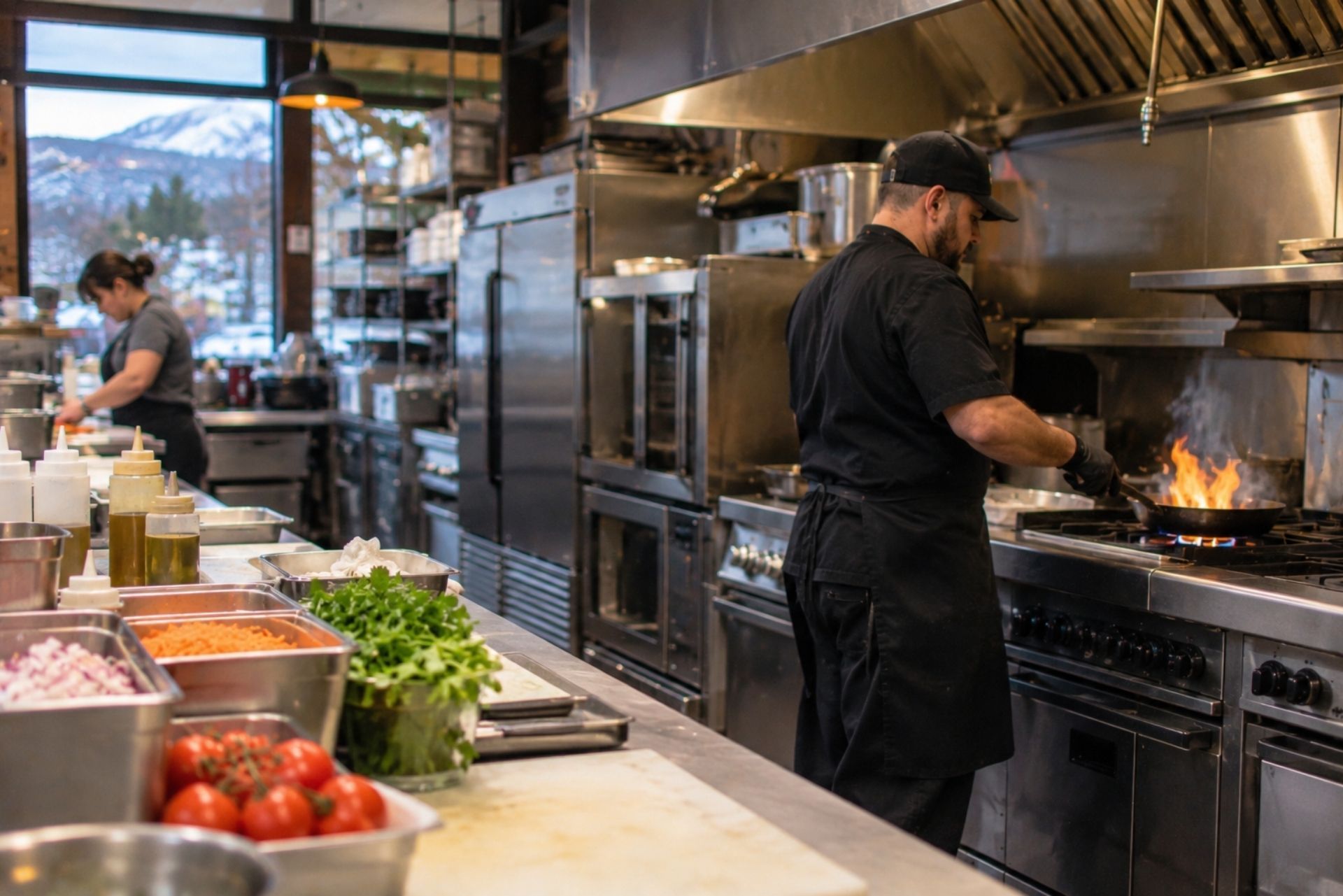
Comparison: Standard BOP vs. Comprehensive Restaurant Packages
A Business Owner's Policy (BOP) bundles general liability and commercial property at a discount. For a small coffee shop or a counter-service lunch spot, a BOP is often enough. Once you add a bar, late hours, a big kitchen, or catering, the generic BOP starts to show holes. That's when a restaurant-specific package earns its price.
| Coverage Feature | Standard BOP | Restaurant Package |
|---|---|---|
| General liability | Included | Included |
| Commercial property | Included | Included, often higher limits |
| Business income | Usually included | Included, often longer period |
| Food spoilage | Low limit or none | Included, higher limits |
| Equipment breakdown | Optional add-on | Often built in |
| Liquor liability | Excluded | Available or bundled |
| Assault and battery | Usually excluded | Can be added back |
| Food contamination closure | Rarely included | Commonly included |
| Best fit | Cafés, bakeries, low-alcohol counter service | Full service, bars, breweries, catering |
The food contamination line deserves a second look. If El Paso County Public Health closes you over an outbreak, contamination coverage can pay for cleanup, discarded inventory, and lost income. A standard BOP usually won't respond, because no physical property damage occurred.
On the flip side, don't overbuy. A drive-through coffee kiosk doesn't need a full restaurant package with $100,000 of spoilage coverage. Match the policy to how you actually operate.
Food trucks are their own category. As of January 1, 2026, a
retail food license from CDPHE or Denver is valid statewide. That lets trucks work in Colorado Springs without a separate local license, though operators must give 14 days' notice to the local health department before working a new area. A truck needs commercial auto in addition to GL, since a BOP or restaurant package won't cover the vehicle on the road.
Workers' Compensation Requirements in El Paso County
Colorado requires workers' comp for virtually any business with even one employee, including part-time staff. Restaurants don't get a pass because staff are seasonal or paid mostly in tips. The Colorado Division of Workers' Compensation enforces the requirement, and penalties for operating uninsured can run up to $250 per day for an initial violation and up to $500 per day for later ones. That adds up fast, and you'd also be personally on the hook for the injured worker's medical bills and lost wages.
Your premium is built from three numbers: payroll, the class code rate, and your Experience Modification Rate (EMR). Restaurant staff usually fall under NCCI class code 9082 for full-service restaurants. Here's a simple illustration with a hypothetical rate:
- Annual payroll: $600,000
- Hypothetical rate: $1.50 per $100 of payroll
- Base premium: $9,000
- With a 1.25 EMR: $11,250
- With a 0.85 EMR: $7,650
That $3,600 swing comes entirely from your claims history. A clean three years pays you back every renewal.
Kitchen injuries are predictable: knife lacerations, burns from fryers and steam, slips on greasy mats, and back strains from hauling 50-pound bags and kegs. Reported tips count as payroll for premium purposes, so keep your payroll reporting accurate. An audit that finds unreported tip income will produce a back-premium bill.
Pinnacol Assurance, Colorado's largest workers' comp carrier, writes many restaurant policies and acts as the state's insurer of last resort. That said, private carriers sometimes beat Pinnacol for restaurants with good loss history. Get both quoted every year.
The best claim cost control tool is a return-to-work program. An injured line cook on light duty can handle inventory counts, prep labeling, temperature logs, or training new hires. Getting someone back on modified duty quickly cuts temporary total disability (TTD) payments and protects your EMR.
I won't throw out a single "average restaurant insurance cost" number. Those figures blend tiny cafés with 200-seat steakhouses and end up useless for budgeting. Your real number depends on your concept, revenue, alcohol mix, and loss history. A better approach is understanding the levers underwriters pull, so you can control the ones you're able to.
Each coverage line is rated on a different base, which surprises a lot of first-time owners:
- General liability: usually rated on gross food sales or square footage.
- Liquor liability: rated on alcohol receipts. A brewery taproom pays far more than a taco shop selling a few margaritas.
- Property: rated on insured values, construction type, roof age, and fire protection.
- Workers' comp: rated per $100 of payroll, adjusted by EMR.
- Equipment breakdown: rated on property values and equipment type.
Factors That Influence Colorado Springs Rates
A few factors carry extra weight locally.
- Roof age and condition. Given the hail exposure, an older roof can mean a higher wind/hail deductible, actual cash value settlement on the roof, or a declined quote. Impact-resistant roofing helps.
- Fire suppression and hood cleaning. A current Ansul-type system with semiannual inspections and documented hood cleaning is non-negotiable for most carriers.
- Alcohol percentage. Underwriters often treat alcohol above roughly 30% to 40% of sales as bar-heavy, which moves you into a more expensive market.
- Hours of operation. Closing after midnight raises both liability and liquor rates.
- Payroll growth. The 2026 wage increase pushes your workers' comp base up even if headcount stays flat.
- Maintenance records. Clean documentation now affects both pricing and whether equipment claims get paid.
- Claims history. Three to five years of loss runs follow you to every carrier.
One common mistake is shopping only on price at renewal. A quote that's $2,000 cheaper often hides a 5% wind/hail deductible, an assault and battery exclusion, or a low spoilage sublimit. Compare declarations pages line by line before you switch.
Common Questions About Colorado Restaurant Insurance
Do I need liquor liability if I only serve beer and wine? Yes. Colorado's dram shop law applies to any licensed alcohol sale, and your GL policy almost certainly excludes alcohol-related claims.
Will my policy cover food that spoils during a power outage? Only if you have spoilage coverage, and some forms cover utility outages only when the outage starts within a set distance of your building. Ask your broker to confirm off-premises power failure is included.
What happens during a workers' comp audit? After the policy year ends, the carrier reviews your actual payroll, including reported tips, and adjusts the premium. If payroll grew, you'll owe more, so keep clean payroll records by class code.
Does my landlord's insurance cover my kitchen equipment? No. The landlord's policy covers the building shell, while your equipment, inventory, and improvements need your own property coverage.
How fast do I need to report an employee injury? Report it to your carrier right away. Colorado generally requires employers to report qualifying injuries to the carrier within 10 days. Late reporting can lead to penalties and makes claims harder to manage.
Can I get coverage for a catering side business? Usually, but tell your carrier first. Off-site events, delivery vehicles, and liquor served at private venues can all fall outside a standard restaurant policy.
Making the Right Choice for Your Venue
The owners who come through bad years intact usually have three things in common. They bought liability limits that match today's higher damage caps. They understood their hail deductible before the storm hit. They kept the maintenance paperwork that makes equipment claims payable. Hail, rising labor costs, and stricter carrier underwriting all make 2026 a year to review coverage you may have set and forgotten.
Your next steps are straightforward. Pull your current declarations pages and check your wind/hail deductible, spoilage sublimit, and liquor and assault coverage. Gather three years of loss runs and your service invoices. Then work with an agent who specializes in restaurants, not a generalist, and have them quote Pinnacol alongside several private carriers for workers' comp.
Choosing the right restaurant coverage in Colorado Springs comes down to matching each policy to how you actually run your business. Get that right and a bad Saturday stays a bad Saturday instead of becoming the end of your restaurant.
About The Author:
John R. Thomas
As Commercial Lines Director and Managing Partner at Loft & Co Insurance Services, I specialize in crafting strategic insurance solutions for businesses—especially contractors, real estate owners, logistics firms, and industry-specific operations. With years of experience in risk management and policy design, I’m committed to delivering clarity, value, and protection that helps you focus on growth.
Contact Us
Risk Management from Real Experts With You in Charge
Professional Policies Designed For Your Business.
Enjoy tailored insurance and risk management solutions customized to your industry and business size.

Colorado Commercial Insurance Blog

Contact Us
Phone
Location
Denver
5990 Greenwood Plaza Blvd, Ste 270
Greenwood Village, CO 80111
Des Moines
130 E 3rd St. Ste 201
Des Moines, IA 50309